Learn the difference between artificial intelligence and generative AI, how they work, where they overlap, and see practical examples in simple terms.
09/18/26 • 599 بازدیدها

AI vs Generative AI: What's the Difference?
Artificial intelligence and generative AI are often used as though they mean the same thing.
They don't.
The confusion is understandable. Generative AI has become one of the most visible parts of artificial intelligence, particularly with the growth of AI chatbots, image generators, coding assistants and other tools that can create content from simple instructions.
But artificial intelligence is the broader field, while generative AI is one category of AI focused on generating new content.
Understanding that difference makes it much easier to make sense of today's AI landscape.
In this guide, we'll look at what AI means, what generative AI means, how they differ, where they overlap, and how both are being used in the real world.
What Is Artificial Intelligence?
Artificial intelligence (AI) is a broad field of computing concerned with creating systems that can perform tasks associated with human intelligence.
Depending on the system, these tasks can include:
-
Recognizing patterns
-
Understanding language
-
Classifying information
-
Making predictions
-
Detecting unusual activity
-
Recommending content
-
Recognizing images
-
Processing speech
-
Supporting decision-making
AI doesn't necessarily have to create anything new.
For example, an AI system designed to detect suspicious credit-card transactions may analyze patterns and flag unusual activity. It doesn't need to write an article or create an image to be considered AI.
Likewise, a recommendation system can analyze information about your activity and suggest a movie or song without generating a new piece of content.
So when we talk about AI, we're talking about a very large technological field that includes many different approaches and applications.
What Is Generative AI?
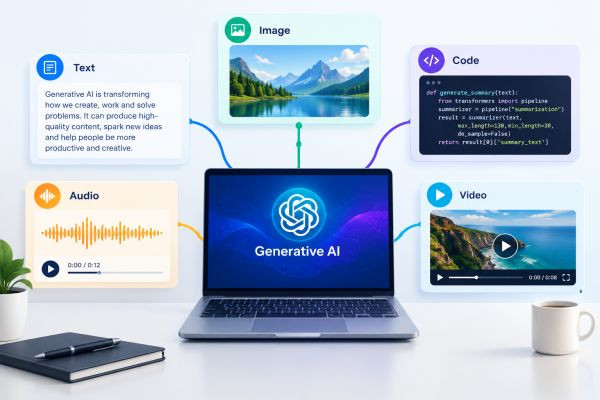
Generative AI is a category of artificial intelligence that can generate new content based on learned patterns and user input.
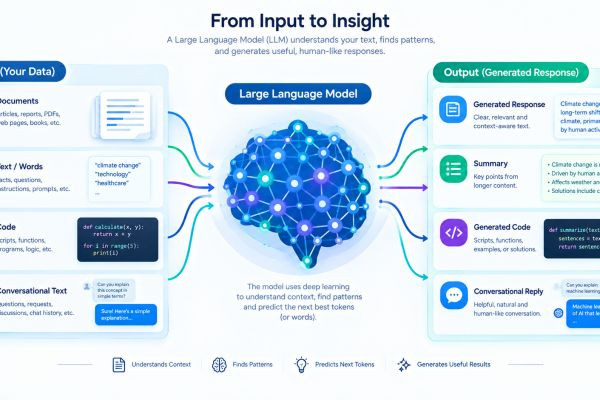
Depending on the system, generative AI can produce:
-
Text
-
Images
-
Audio
-
Video
-
Computer code
For example, a user might provide a written instruction and ask a generative AI application to create a product description, explain a difficult concept, produce an image concept or generate sample code.
The system then produces an output based on the prompt and the capabilities of the underlying model.
This is why generative AI has become so visible: people can interact with it directly and see the results almost immediately.
AI vs Generative AI: The Basic Difference
The easiest way to understand the relationship is:
Artificial intelligence is the larger field. Generative AI is one area within that field that focuses on generating content.
Think of AI as a large umbrella.
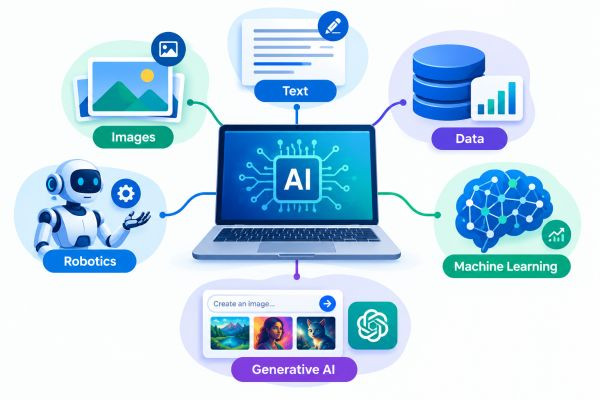
Under that umbrella are many different types of systems, including systems for:
-
Prediction
-
Classification
-
Recommendation
-
Recognition
-
Automation
-
Content generation
Generative AI belongs under that same umbrella.
It is not a separate technology unrelated to AI.
It is AI designed to generate new outputs.
A Simple Example
Imagine an online store.
The store could use an AI system to analyze customer behavior and predict which products someone might be interested in.
That's an example of AI being used for prediction or recommendation.
Now imagine the store uses a generative AI system to create a first draft of a product description.
That's an example of generative AI.
Both systems use artificial intelligence, but they perform different tasks.
AI vs Generative AI: Key Differences
| Feature | Artificial Intelligence | Generative AI |
|---|---|---|
| Meaning | Broad field of intelligent computing systems | Category of AI focused on generating content |
| Main purpose | Can analyze, predict, classify, recognize or automate tasks | Creates new content or other outputs |
| Generates content? | Some AI systems do | Yes, that's a central capability |
| Makes predictions? | Yes | Some systems can |
| Recognizes patterns? | Yes | Yes |
| Can process language? | Some systems | Many generative AI systems can |
| Can create images? | Some AI systems | Image-generating systems can |
| Can generate code? | Some AI systems | Code-generating systems can |
| Examples | Recommendation systems, fraud detection, speech recognition | Text, image, audio, video and code generation |
The categories can overlap, so this table should be viewed as a simplified explanation rather than a strict technical boundary.
How Does Traditional AI Work?
There isn't one single way that every AI system works.
Different applications use different algorithms, models and data.
However, many AI systems are designed to identify patterns in information and use those patterns to produce a prediction, classification, recommendation or other output.
For example, imagine a system designed to identify whether an email is likely to be spam.
It can be trained using examples of unwanted and legitimate messages.
The system can learn patterns associated with those examples and use them when processing a new message.
The output might simply be:
Likely spam
or:
Likely legitimate
The system has performed an AI-related task without generating a new article, image or video.
How Does Generative AI Work?
Generative AI also relies on models that learn patterns from data, but its goal is different.
A simplified process looks like this:
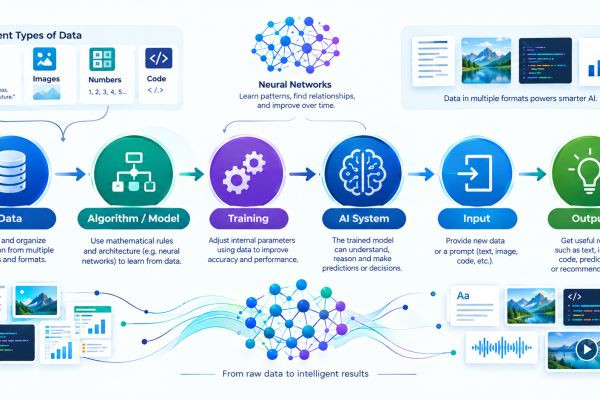
Training data → model learns patterns → user provides prompt → model generates output
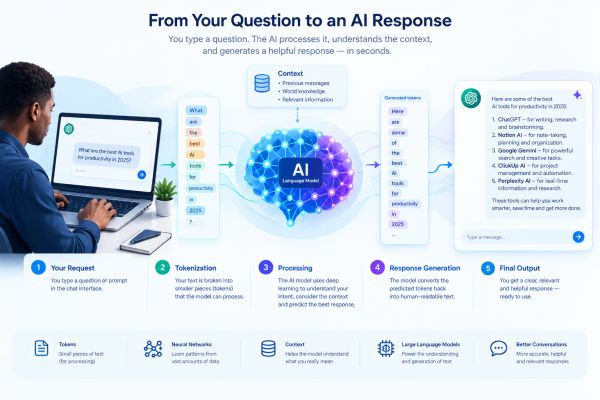
For a language-generation system, the model can process a prompt and generate a sequence of tokens that forms a response.
For an image-generation system, the process can involve generating visual content based on a textual or other input.
The technical details vary significantly between different types of generative AI models.
The important idea is that the system uses what it learned during training to produce a new output based on the input it receives.
Does All AI Generate Content?
No.
This is one of the easiest ways to understand the distinction.
Consider these examples:
AI-powered fraud detection: identifies potentially suspicious transactions.
AI recommendation system: suggests products, songs or videos.
AI image recognition: identifies objects or features in an image.
Generative AI writing tool: produces new text.
Generative AI image tool: creates an image based on a prompt.
The first three can use AI without their primary purpose being content generation.
The last two are examples of generative AI.
Does Generative AI Use Machine Learning?
Many modern generative AI systems are built using machine-learning techniques.
Machine learning is itself an important approach within artificial intelligence.
This creates a relationship that can be confusing at first:
Artificial Intelligence → Machine Learning → Deep Learning → Some modern Generative AI systems
This isn't a perfect hierarchy for every AI technology, but it is a useful beginner-friendly way to understand how several commonly discussed concepts relate to one another.
For example, many modern generative AI systems rely on deep-learning techniques.
What Is the Difference Between AI, Machine Learning and Generative AI?
These three terms are related but shouldn't be treated as interchangeable.
Artificial Intelligence
AI is the broadest term.
It describes the larger field of creating computer systems capable of performing tasks associated with intelligence.
Machine Learning
Machine learning is an approach within AI where systems learn patterns from data.
Rather than manually programming every possible situation, developers can train models using examples.
Generative AI
Generative AI refers to AI systems that generate new content or other outputs.
A modern generative AI system may use machine learning and deep learning techniques underneath.
So:
AI is the broad field.
Machine learning is one major approach within AI.
Generative AI describes systems capable of generating new content.
Examples of AI That Aren't Primarily Generative AI
It's useful to look beyond chatbots because today's public discussion can make AI seem synonymous with generative AI.
Recommendation Systems
A streaming platform can analyze viewing or listening patterns and recommend content.
Fraud Detection
Financial institutions can use automated systems to identify patterns associated with potentially suspicious transactions.
Predictive Systems
Machine-learning systems can be used to make predictions from historical or real-time data.
Image Recognition
AI systems can analyze images and identify objects, patterns or other characteristics.
Spam Detection
Email services can use automated systems to identify messages that are likely to be unwanted.
These examples demonstrate that AI existed long before generative AI became a mainstream consumer technology.
Examples of Generative AI
Generative AI has a different emphasis.
AI Text Generation
A user can provide an instruction and receive generated text.
Potential applications include:
-
Drafting
-
Brainstorming
-
Summarization
-
Explanations
-
Content planning
-
Coding assistance
AI Image Generation
Some systems can generate images based on written descriptions or other inputs.
AI Audio Generation
Generative AI can be used to create or transform certain forms of audio.
AI Video Generation
Some AI systems can generate or modify video content from text, images or other inputs.
AI Code Generation
Developers can use generative AI to create code examples, explain existing code or assist with programming tasks.
The capabilities of individual tools vary, and users should review AI-generated output before relying on it.
Why Do People Confuse AI and Generative AI?
There are a few reasons.
Generative AI Is Highly Visible
People can interact directly with a chatbot or image generator and immediately see something being produced.
That makes generative AI easier to notice than an AI system quietly working behind the scenes.
AI Is Often Used as a General Term
Companies, journalists and everyday users sometimes use "AI" as a shorthand for a wide range of technologies.
Someone might say:
"I used AI to write this."
They may actually mean they used a generative AI application.
The statement isn't necessarily wrong in everyday conversation, but it doesn't tell us which kind of AI technology was involved.
Many Modern Products Combine Multiple AI Capabilities
A single application may include recommendation systems, language models, image recognition and generative features.
This makes the boundaries less obvious to users.
Is Generative AI More Advanced Than AI?
This isn't really the right way to compare them.
Generative AI is a category within AI, not a replacement for AI as a whole.
It's similar to asking whether a particular type of vehicle is "more advanced" than transportation.
They describe different levels of the technology.
Some AI systems are extremely sophisticated without generating content, while some generative AI systems are designed for relatively narrow tasks.
The more useful question is:
What problem is the AI system designed to solve?
Which Is More Useful: AI or Generative AI?
There isn't one answer because they aren't competing technologies.
The useful choice depends on the task.
If a company wants to detect suspicious transactions, it may need an AI system designed for that purpose.
If a marketing team wants help brainstorming content, a generative AI application might be useful.
If a developer wants assistance understanding code, a generative AI coding tool may help.
If a streaming service wants to recommend movies, a recommendation system may be more appropriate.
The technology should match the problem.
What Can Generative AI Do That Traditional AI Doesn't?
Generative AI is particularly useful when the desired output is something new or variable.
For example, instead of simply classifying a document as "important" or "not important," a generative AI system could potentially summarize the document.
Instead of identifying an object in a picture, an image-generation system can create a new image based on a description.
Instead of simply detecting an error in code, a coding assistant can suggest a possible correction or explain the problem.
Again, these capabilities depend on the particular model and application.
What Are the Risks of Generative AI?
Generative AI introduces some challenges that users should understand.
Incorrect Information
AI-generated content can contain factual errors.
A fluent response isn't proof that the information is correct.
Bias
AI outputs can reflect biases present in training data, system design or other parts of the development process.
Privacy
Users should be careful when providing confidential or sensitive information to AI services.
Copyright and Ownership
The legal treatment of AI-generated material can depend on the circumstances, jurisdiction, tool and content involved.
Users should check applicable terms and laws when using AI commercially.
Over-Reliance
Using AI for every task can discourage people from developing their own understanding and judgment.
AI is often more useful when it assists human thinking rather than replacing it completely.
How Should Beginners Think About AI?
If you're new to AI, don't worry too much about memorizing every technical term.
Start with the relationships between the major concepts.
A useful mental model is:
Artificial Intelligence
↓
A broad field containing many different approaches
↓
Machine Learning
↓
An important approach for learning patterns from data
↓
Deep Learning
↓
A machine-learning approach using multi-layer neural networks
↓
Generative AI
↓
AI systems capable of generating new content
Again, this is a simplified learning model. The actual AI field contains many techniques and overlapping categories.
Should You Learn AI or Generative AI?
For someone beginning today, learning the fundamentals of both is useful.
You don't necessarily have to become a machine-learning engineer.
Instead, you can develop AI literacy.
That means understanding:
-
What AI can do
-
What generative AI can do
-
How AI systems can fail
-
How to write useful prompts
-
How to evaluate AI-generated information
-
How to protect sensitive information
-
When human expertise is necessary
From there, you can choose a direction that matches your goals.
You might be interested in:
-
AI for business
-
AI for education
-
AI for content creation
-
AI-assisted programming
-
Data analysis
-
AI automation
-
Generative AI
-
AI-related careers
Frequently Asked Questions
Is AI and generative AI the same thing?
No.
Artificial intelligence is the broader field. Generative AI is a category within AI that focuses on generating new content or outputs.
Is ChatGPT AI or generative AI?
ChatGPT is an AI application that uses generative AI technology to generate responses to user prompts.
Is machine learning the same as generative AI?
No.
Machine learning is an approach used within artificial intelligence. Generative AI refers to AI systems designed to generate new content.
Can AI generate images?
Some AI systems can generate images. These systems fall within the broader area of generative AI.
Can traditional AI create content?
Some AI systems can generate content, so the distinction isn't always "traditional AI versus content generation."
The important point is that generative AI specifically refers to AI systems whose capabilities include generating new content or outputs.
Which came first, AI or generative AI?
Artificial intelligence as a field predates today's generative AI applications by many decades.
Generative AI builds on developments in machine learning, deep learning and other areas of AI research.
Do I need to learn programming before learning generative AI?
No.
You can learn the basic concepts and practical uses of generative AI without programming.
Programming becomes increasingly important if you want to develop AI applications or work in technical AI roles.
Final Thoughts
Artificial intelligence is much bigger than generative AI.
AI includes systems that can recognize patterns, make predictions, classify information, recommend content and perform many other tasks.
Generative AI is a particular category of AI that focuses on producing new content such as text, images, audio, video and code.
Once you understand this relationship, many of the AI terms you hear every day become easier to put into context.
And this is only the beginning.
In the next part of the OriginCourse AI series, we'll move from what AI is to how it actually works.
Next article: How Does Artificial Intelligence Work? A Beginner-Friendly Explanation.
Keep exploring AI, technology and practical digital skills with OriginCourse.
مقالات مرتبط