- IA et IA générative
- Technologie et programmation
- Commerce et entrepreneuriat
- Marketing numérique
- Microsoft Office et productivité
- Données et analyses
- Finance et comptabilité
- Compétences en conception et création
- Développement de carrière et professionnel
- Travail indépendant et télétravail
- Comment styliser
- Éducation et enseignement
- Foi
Learn how artificial intelligence works, from data and algorithms to machine learning, training, models and predictions, with simple real-world examples.
09/18/26 • 507 Vues

How Does Artificial Intelligence Work? A Beginner-Friendly Explanation
Artificial intelligence can seem complicated from the outside.
You type a question into an AI chatbot and receive an answer. A phone recognizes your face. A streaming service recommends a movie. A navigation app suggests a different route because traffic has changed.
It can feel like the computer somehow "knows" what to do.
But there is a process behind these results.
Modern AI systems rely on things such as data, algorithms, models, training and computing power to identify patterns and produce useful outputs.
You don't need an advanced degree in computer science to understand the basic idea.
In this guide, we'll break down how artificial intelligence works, explain the role of machine learning and neural networks, look at how AI models are trained, and use simple examples to make the technology easier to understand.
How Does Artificial Intelligence Work?
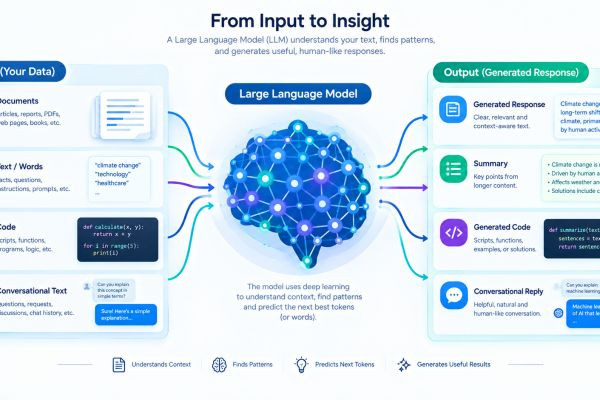
At a high level, an AI system takes information as an input, processes it using a model or other computational methods, and produces an output.
A simplified version looks like this:
Data → Learning or processing → AI model → Input → Output
The exact process depends on the type of AI system.
An AI application designed to recognize objects in photographs doesn't work exactly like a chatbot. A recommendation system doesn't work exactly like an image generator.
But many modern AI systems share some important concepts.
These include:
-
Data
-
Algorithms
-
Models
-
Training
-
Parameters
-
Inference
-
Computing resources
Let's look at each one.
What Role Does Data Play in AI?
Data is one of the foundations of modern artificial intelligence.
AI systems can work with many types of information, including:
-
Text
-
Images
-
Audio
-
Video
-
Numbers
-
Sensor readings
-
User interactions
The type of data depends on what the AI system is designed to do.
For example, a system designed to recognize objects in photographs needs visual data.
A system designed to process language needs language data.
A system designed to predict customer demand may work with sales and other business data.
Why Does Data Quality Matter?
More data isn't automatically better.
Data can contain:
-
Errors
-
Missing information
-
Duplicates
-
Biases
-
Irrelevant information
If the data used to develop an AI system has significant problems, those problems can affect the resulting system.
This is why data preparation and evaluation are important parts of AI development.
What Is an AI Algorithm?
An algorithm is a defined computational procedure for solving a problem or carrying out a task.
Algorithms are not unique to AI. Computers have used algorithms for many decades.
What makes some AI systems different is that machine-learning approaches can allow the system to learn patterns from examples instead of requiring programmers to specify every rule manually.
For example, consider an email spam filter.
A traditional rule-based system might contain instructions such as:
If an email contains certain words, mark it as spam.
A machine-learning system can instead be trained using many examples of spam and legitimate emails.
The model can learn patterns associated with those examples and use them when evaluating new messages.
This distinction is important.
What Is Machine Learning?
Machine learning is an approach to artificial intelligence in which computer systems learn patterns from data and use those patterns to make predictions or decisions.
Rather than programming every possible answer, developers provide data and use algorithms that allow a model to learn useful relationships within that data.
For example, suppose you wanted to predict house prices.
You could provide a model with historical information such as:
-
Property size
-
Location
-
Number of rooms
-
Property type
-
Previous sale price
The model can learn relationships between those factors and historical prices.
When it receives information about another property, it can produce a prediction.
The prediction won't necessarily be correct.
The model is making an estimate based on patterns it learned.
What Is an AI Model?
An AI model is a computational system that has learned patterns from data or has otherwise been configured to perform a particular task.
Think of a model as the part of the system that uses what it has learned to process new information.
For example:
Training:
The model learns from examples.
Inference:
The trained model processes new information and produces an output.
The model itself can be very complex, especially in modern deep-learning systems.
What Does AI Training Mean?
Training is the process through which a machine-learning model learns patterns from data.
A simplified example can help.
Imagine training a system to distinguish between pictures of cats and dogs.
You provide many labeled examples.
The model examines the examples and adjusts its internal parameters as it learns.
Over time, the model becomes better at identifying patterns that help distinguish the categories.
Eventually, you can give it an image it hasn't seen before and ask it to make a prediction.
The model isn't necessarily following a simple human-readable rule.
It has learned a mathematical representation of patterns in the training data.
What Are Parameters in an AI Model?
You may hear the word parameters frequently when people discuss modern AI models.
Parameters are internal values that a model adjusts during training.
They help determine how the model responds to different inputs.
Large AI models can contain enormous numbers of parameters.
However, a larger number of parameters doesn't automatically mean that one model will be better for every task.
Model architecture, training methods, data, evaluation and many other factors also matter.
For beginners, the simplest way to think about parameters is:
Parameters are internal values that a model learns and uses when producing its outputs.
What Is Inference in AI?
Once a model has been trained, it can be used to process new information.
This is commonly called inference.
For example:
Training:
An image model learns patterns from many examples.
Inference:
You give the trained model a new image.
Output:
The model predicts what the image may contain.
The same basic idea applies to many AI applications.
A language model receives text and generates a response.
A recommendation model receives information and produces recommendations.
A classification model receives data and predicts a category.
How Does an AI System Learn?
The phrase "AI learns" can make it sound as though a computer learns in exactly the same way a person does.
It doesn't.
In machine learning, learning generally means that a model's internal parameters are adjusted during training so that it becomes better at a particular objective.
The process can involve:
Examples → prediction → comparison with expected result → adjustment → repeat
The exact method depends on the machine-learning approach being used.
What Is Supervised Learning?
Supervised learning uses training examples where the desired answer or label is provided.
For example, imagine a dataset containing thousands of emails labeled:
-
Spam
-
Not spam
A supervised-learning system can use these examples to learn patterns associated with each category.
It can then classify new emails.
Supervised learning is commonly used for tasks such as:
-
Classification
-
Prediction
-
Regression
What Is Unsupervised Learning?
Unsupervised learning involves finding patterns or structures in data without having predefined labels for every example.
For instance, a business could use an unsupervised-learning technique to identify groups of customers with similar behavior.
The system may discover clusters or patterns that weren't explicitly labeled beforehand.
This can be useful for:
-
Customer segmentation
-
Pattern discovery
-
Data exploration
-
Anomaly detection
What Is Reinforcement Learning?
Reinforcement learning is a machine-learning approach in which an agent learns through interactions with an environment and receives feedback related to its actions.
A simplified example would be an AI system learning to play a game.
It takes an action, receives feedback, and uses that experience to improve its future behavior.
Reinforcement learning can involve concepts such as:
-
Actions
-
States
-
Rewards
-
Policies
-
Environments
The details can become mathematically complex, but the basic idea is learning through interaction and feedback.
What Are Neural Networks?
A neural network is a machine-learning model inspired loosely by the structure of biological neural networks.
It consists of interconnected computational units arranged in layers.
A simplified neural network may have:
Input layer → hidden layers → output layer
The network processes information through these layers and adjusts parameters during training.
Neural networks are particularly important in modern AI because they can learn complex patterns from large datasets.
What Is Deep Learning?
Deep learning is a type of machine learning that uses neural networks with multiple layers.
The additional layers allow these systems to learn increasingly complex representations of data.
Deep-learning techniques have contributed to major advances in areas such as:
-
Computer vision
-
Speech recognition
-
Natural-language processing
-
Generative AI
For example, an image model may learn increasingly complex visual patterns across different layers.
Early representations might capture relatively simple features, while later layers can combine them into more complex patterns.
The actual operation of modern neural networks is much more complicated than this simplified explanation, but the concept provides a useful starting point.
How Does AI Understand Language?
This is particularly interesting because language is complicated.
Words can have different meanings depending on context.
People can use sarcasm, slang, incomplete sentences and cultural references.
Modern language models use sophisticated machine-learning techniques to process relationships between pieces of language.
Rather than understanding language exactly as a human brain does, a language model processes patterns represented mathematically.
This allows it to perform tasks such as:
-
Generating text
-
Summarizing information
-
Answering questions
-
Translating
-
Classifying text
-
Writing or explaining code
Large language models are a major part of modern generative AI, and we'll explore them separately in a later article.
How Does Generative AI Produce New Content?
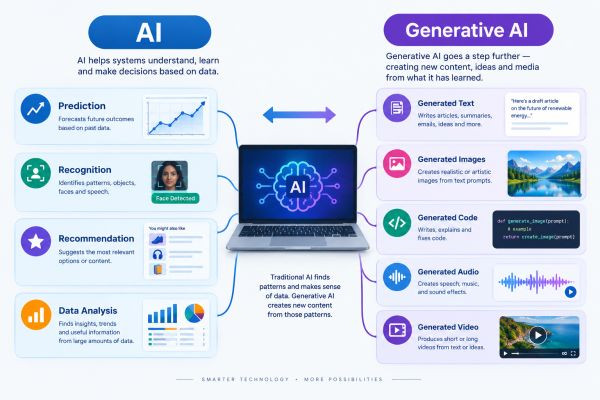
Generative AI follows the same broad foundation of data, models and machine learning, but its purpose is to generate outputs.
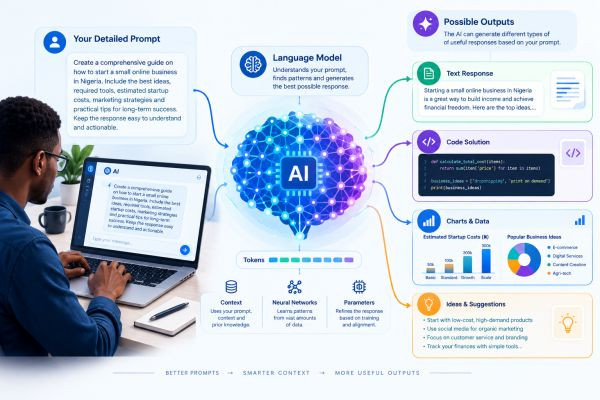
For example, a language model can receive:
"Explain compound interest to a beginner."
It processes the prompt and generates a response.
A text-to-image model can receive a description of an image and generate a visual output.
A code-generation model can receive a programming request and produce code.
The model isn't simply searching a traditional database and copying one stored response.
It uses patterns learned during training to generate an output based on the input.
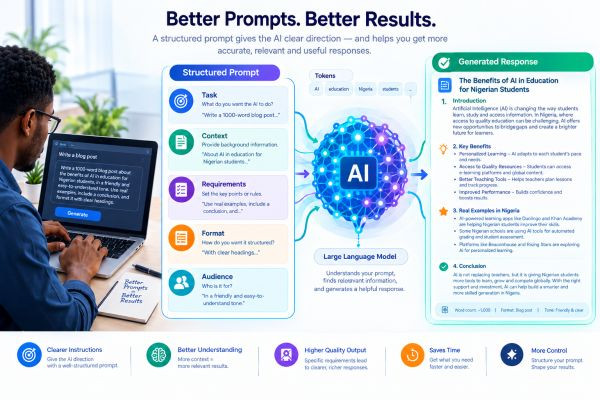
For language models, generation involves predicting tokens as part of producing a response.
This is one reason the exact wording of an answer can change from one interaction to another.
Why Does AI Sometimes Get Things Wrong?
This is one of the most important things beginners should understand.
An AI system can produce an answer that sounds confident without being correct.
There are several possible reasons.
Training Data Limitations
A model's training process depends on the data and methods used to build it.
If important information isn't available to the model or isn't represented adequately, its output can be limited.
Model Limitations
Even a highly capable model can make mistakes.
Models are not perfect representations of the world.
Ambiguous Inputs
A vague prompt can lead to an output that doesn't match what the user intended.
Generative Errors
Generative models can produce plausible-looking information that isn't supported by reliable evidence.
This is one reason important information should be verified.
Does AI Actually "Think"?
The answer depends heavily on what someone means by "think."
AI systems can perform sophisticated forms of computation, reasoning-like tasks and pattern processing.
However, that doesn't mean they necessarily think or experience the world in the same way humans do.
For practical purposes, it is safer to describe AI in terms of what it can computationally do rather than assuming that human-like understanding exists simply because the output sounds intelligent.
A Simple Example: How an AI Recommendation System Works
Imagine a music application.
You listen to several songs.
The system can collect information about your interactions and identify patterns.
It may also consider relationships between songs, artists, genres or other signals.
A recommendation model can then estimate which songs might be relevant to you.
You receive recommendations.
When you interact with those recommendations, that information may become another signal used by the system.
This illustrates a common AI workflow:
Data → pattern identification → prediction → recommendation
The actual systems used by large technology companies are much more complex, but this simplified model helps explain the basic idea.
A Simple Example: How an AI Image Classifier Works
Imagine a system designed to identify whether an image contains a particular object.
During training, it processes many examples.
The model learns visual patterns that can help distinguish the target object from other content.
Later, you provide a new image.
The trained model analyzes it and produces a prediction.
It might output something like:
Object detected: Yes
or:
Object detected: No
The model is not necessarily "looking" at the picture in the same way a person does. It processes numerical representations of the image using its learned parameters.
A Simple Example: How a Generative AI Chatbot Works
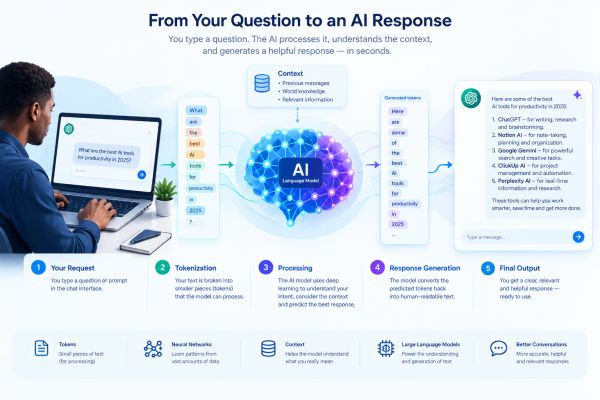
Now consider a chatbot.
You enter:
"Explain photosynthesis in simple language."
Your text is converted into a representation the model can process.
The model analyzes the prompt in context and generates an output token by token.
The resulting sequence becomes the answer you see.
The underlying system can involve an enormous neural network and sophisticated processing, but the user experience is simple:
Prompt → model processing → generated response
This is one of the most accessible examples of generative AI today.
Does AI Learn After Every Conversation?
This is an important question, and the answer depends on the particular AI product and how its memory, personalization and training systems are designed.
A conversation with an AI system should not automatically be interpreted as the underlying model permanently learning from that conversation in real time.
Different services have different approaches to conversation history, memory, data retention and model improvement.
If privacy matters, check the specific service's current documentation and settings rather than assuming how it handles your information.
What Does AI Need to Work?
AI systems can require significant technical infrastructure.
Depending on the application, this can include:
-
Data
-
Algorithms
-
Machine-learning models
-
Computing hardware
-
Storage
-
Software
-
Networking
-
Human expertise
Large AI models can require substantial computing resources during training and operation.
Smaller AI systems may require considerably less.
Why Are GPUs Important for AI?
You may have heard about GPUs, or graphics processing units, in discussions about AI.
GPUs were originally developed primarily for graphics-related computation, but their ability to perform many mathematical operations in parallel makes them useful for many machine-learning workloads.
Modern AI development can use GPUs and other specialized hardware to accelerate model training and inference.
This is one reason demand for AI computing infrastructure has grown significantly.
Can AI Work Without the Internet?
Sometimes.
Not every AI system needs a live internet connection.
Some AI applications can run locally on a computer, phone or other device.
Other systems depend on cloud servers and internet connectivity.
It depends on the particular model, application and architecture.
An AI chatbot running through an online service, for example, may send requests to remote servers, while a smaller model could potentially run directly on a device.
What Is an AI Model's Training Process Like?
A simplified training process might look like this:
Step 1: Collect Data
Developers gather data appropriate for the intended task.
Step 2: Prepare the Data
The data may need to be cleaned, filtered, formatted or otherwise processed.
Step 3: Choose a Model Architecture
Developers select an approach suitable for the problem.
Step 4: Train the Model
The model processes examples and adjusts its parameters.
Step 5: Evaluate the Model
Developers test how well the model performs.
Step 6: Improve the System
The training process, data, model or other components may be adjusted.
Step 7: Deploy the Model
The resulting system can be made available for users or integrated into another application.
This is a simplified overview. Real-world AI development can involve many additional stages.
Why Does AI Need So Much Data?
Not every AI system needs massive amounts of data.
However, many modern machine-learning systems benefit from large and diverse datasets.
More relevant examples can give a model more opportunities to learn useful patterns.
But quantity isn't the only consideration.
Quality, diversity, relevance and how the data is processed also matter.
A huge collection of poor-quality data isn't automatically better than a smaller, carefully prepared dataset.
What Is the Difference Between Training and Using an AI Model?
This distinction is worth remembering.
Training is when the model's parameters are adjusted using data.
Inference is when the trained model is used to process new inputs and generate outputs.
Think of it like preparing for an exam.
Training is the learning process.
Inference is using what you've learned when you encounter a new question.
The analogy isn't perfect, but it makes the distinction easier to remember.
Why Does AI Continue to Improve?
AI systems can improve through advances in several areas:
-
Better model architectures
-
Better training methods
-
Improved data
-
More computing power
-
Better evaluation
-
Improved software
-
New research techniques
Progress doesn't come from simply making models bigger.
Researchers and engineers work on many different aspects of AI systems.
How Can a Beginner Start Understanding AI?
You don't have to learn everything at once.
A good starting path is:
1. Understand the Vocabulary
Learn the difference between:
-
AI
-
Machine learning
-
Deep learning
-
Neural networks
-
Generative AI
-
Large language models
-
Training
-
Inference
2. Experiment With AI
Use accessible AI applications and observe how they respond to different inputs.
3. Learn Basic Prompting
Try changing the amount of context, detail and structure in your instructions.
You'll quickly see how the input can affect the output.
4. Learn About AI Limitations
Don't only study what AI can do.
Understand why AI can produce errors, biased outputs or misleading information.
5. Go Deeper if You Enjoy the Technical Side
If you discover that you enjoy the technology itself, you can move into:
-
Python
-
Mathematics
-
Statistics
-
Data science
-
Machine learning
-
Deep learning
-
Neural networks
-
AI development
There is no requirement to follow the technical route, however.
AI literacy can be useful even for people who never build an AI model themselves.
Frequently Asked Questions
How does artificial intelligence work in simple terms?
AI systems process information using algorithms and models. Many modern AI systems use machine learning to identify patterns in data and then use those learned patterns to make predictions, classifications, recommendations or generate outputs.
How does AI learn?
In machine learning, a model learns by processing examples and adjusting internal parameters according to a particular training objective.
Does AI learn like humans?
No. Machine learning is not the same process as human learning. AI models learn mathematical patterns through computational training processes.
What is the difference between AI and machine learning?
AI is the broader field. Machine learning is one major approach used to create AI systems by allowing models to learn patterns from data.
What is deep learning?
Deep learning is a type of machine learning based on neural networks with multiple layers.
How does generative AI work?
Generative AI uses trained models to produce new outputs based on input instructions and learned patterns. Different types of generative AI use different architectures and techniques.
Why does AI make mistakes?
AI can make mistakes because models have limitations, training data can have problems, inputs can be ambiguous, and generative systems can produce plausible but incorrect outputs.
Does AI have a brain?
No. An AI model isn't a biological brain. It is a computational system consisting of mathematical operations, parameters, software and other technical components.
Can I learn AI without programming?
Yes.
You can learn AI concepts and use many AI applications without programming.
Programming becomes more important if you want to build AI systems or pursue technical AI work.
Final Thoughts
Artificial intelligence can look mysterious when you only see the final result.
But once you break the process down, the basic ideas become easier to understand.
AI systems can use data, algorithms, models and computing resources to process information and identify patterns. Machine-learning systems can adjust their internal parameters during training, and trained models can then process new information during inference.
Generative AI builds on these ideas to produce new content such as text, images, audio, video and code.
There is still a great deal of technical detail beneath the surface, but you don't need to understand all of it before you can start learning.
Start with the fundamentals, experiment with the technology, question the results and gradually go deeper.
That's a much more useful way to learn AI than simply memorizing technical terms.
Continue the OriginCourse AI series:
→ What Is a Large Language Model (LLM)? A Simple Explanation
→ How Do AI Chatbots Like ChatGPT Actually Work?
→ What Is an AI Prompt? A Beginner's Guide to Prompting
Explore more practical technology and digital-skills learning resources on OriginCourse.
Articles Liés