- AI och generativ AI
- Teknik och programmering
- Affärer och entreprenörskap
- Digital marknadsföring
- Microsoft Office och produktivitet
- Data och analys
- Finans och redovisning
- Design och kreativa färdigheter
- Karriär- och professionell utveckling
- Frilansarbete och distansarbete
- How-to & Style
- Utbildning och undervisning
- Tro
What is an LLM? Learn how large language models work, what tokens and parameters mean, how LLMs generate text, their uses, limitations and more.
09/18/26 • 596 Visningar

What Is a Large Language Model (LLM)? A Simple Explanation
If you have used an AI chatbot to ask a question, summarize a document, write an email, explain a difficult topic, or help with computer code, there is a good chance you have interacted with a large language model, commonly called an LLM.
The term can sound complicated, but the basic idea is easier to understand than it first appears.
A large language model is an artificial intelligence system trained on large amounts of text so that it can recognize patterns in language and generate useful text in response to an input.
But an LLM is not simply a huge database of sentences. It does not normally search through its training material and copy an answer word for word. Instead, it uses patterns learned during training to predict and generate sequences of text.
So, what is an LLM, how does it work, and why has it become such an important part of modern AI?
Let's break it down.
What Does LLM Mean?
LLM stands for Large Language Model.
Each part of the name tells us something important:
- Large — these models can contain very large numbers of learned parameters and are generally trained using substantial amounts of data and computing resources.
- Language — they are designed primarily to work with human language, although many modern models can also work with things such as code and other forms of information.
- Model — it is a mathematical system trained to recognize patterns and produce outputs based on inputs.
In simple terms:
An LLM is an AI model trained to process and generate language by learning patterns from large amounts of data.
This is one reason LLMs can perform tasks such as answering questions, rewriting text, summarizing information, translating languages, brainstorming ideas, and generating computer code.
How Does a Large Language Model Work?
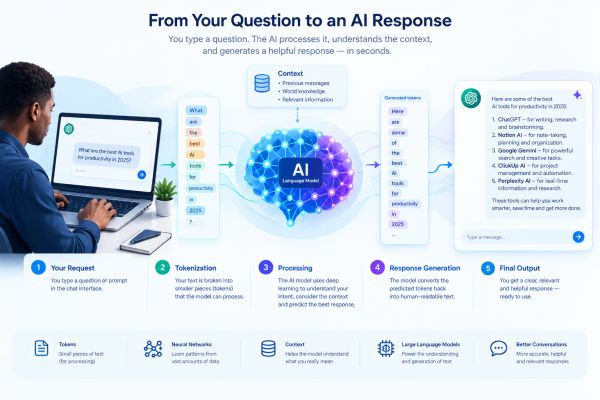
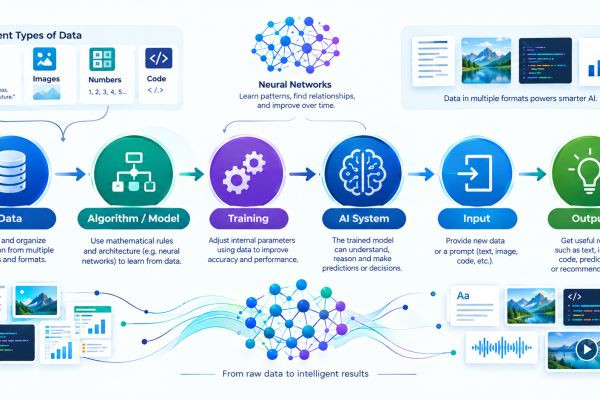
At a very high level, an LLM works through a process that looks something like this:
Training data → Training → Learned patterns → Model → Prompt → Generated response
The process is much more complicated under the hood, but this gives beginners a useful mental model.
Let's look at each part.
1. Training Data
Before an LLM can generate useful language, it needs to be trained.
Training involves exposing the model to large collections of data.
Depending on the model and its development process, this may include different types of text and other data sources.
The important point is that the model is not born knowing how language works.
It learns statistical patterns from examples.
For instance, after processing many examples of language, a model can learn that certain words, phrases, structures and concepts frequently appear together.
It can also learn patterns associated with grammar, programming syntax, different writing styles and relationships between concepts.
2. The Model Learns Patterns
During training, the system adjusts its internal parameters to become better at its training objective.
You can think of parameters as values inside the model that are adjusted during training.
There can be billions or more of these values in large models.
You do not need to understand the mathematics behind every parameter to understand the basic concept.
A simple analogy is learning a language.
A child does not memorize one giant list containing every possible sentence they may hear. Through exposure and practice, they gradually develop an understanding of patterns in language.
An LLM works very differently from a human, but the analogy helps explain why exposure to many examples matters.
What Are Tokens?
One of the most important concepts for understanding LLMs is the token.
An LLM does not necessarily process text exactly as humans see it.
Text is broken into smaller pieces called tokens.
A token might represent:
- A complete word
- Part of a word
- Punctuation
- A number
- A space or other text element, depending on the tokenizer
For example, a sentence such as:
"Artificial intelligence is changing technology."
would be converted into tokens before being processed by the model.
The exact tokenization depends on the particular model and tokenizer.
This matters because LLMs generally process and generate text in terms of these smaller units rather than simply treating an entire paragraph as one object.
What Does an LLM Actually Predict?
Here is one of the most important ideas to understand:
Many language models generate text by predicting what token should come next based on the context available to the model.
Suppose you write:
"The sun rises in the..."
A language model may assign a high probability to a token associated with "east."
The model then continues the generation process one step at a time.
This does not mean the model simply picks the single most obvious word every time.
Modern language-model generation involves probabilities and additional mechanisms that influence which token is selected.
This is why asking the same question multiple times can sometimes produce different responses.
Does an LLM Understand Language?
This is where things become more interesting.
It is tempting to say that an LLM "understands" language exactly like a human does.
That would be misleading.
LLMs can process complex language patterns and produce remarkably coherent responses, but their operation is fundamentally different from human cognition.
An LLM does not have human experiences, personal memories, emotions or a physical life in the world simply because it can generate convincing language.
It is better to say that an LLM has learned complex patterns that allow it to process and generate language.
This distinction becomes particularly important when evaluating AI-generated information.
A response can sound confident and intelligent while still containing an error.
What Are Parameters in an LLM?
You will often hear people describe an AI model as having billions of parameters.
But what exactly does that mean?
Parameters are learned numerical values within a model that are adjusted during training.
You can think of them—very loosely—as part of the model's internal configuration for representing patterns.
A larger number of parameters does not automatically mean a model will be better at every task.
Model performance also depends on many other factors, including:
- Training data
- Training methods
- Model architecture
- Fine-tuning
- Evaluation
- Inference methods
- Hardware and computing resources
- The particular task being performed
So, when you hear that one model has more parameters than another, that number alone does not tell you everything about the model's capabilities.
What Is the Context Window?
Another important LLM concept is the context window.
The context window refers to the amount of information a model can consider within a particular interaction or processing request, measured in tokens.
This can include things such as:
- Your current prompt
- Earlier messages in a conversation
- Text supplied for analysis
- Instructions
- Other information provided to the model
A larger context window can allow a model to work with longer inputs, although the exact behavior depends on the model and application.
For example, imagine asking an AI system to summarize a long document.
The model needs to receive the relevant text as part of the context available to it.
This is one reason context limits matter when working with large documents or lengthy conversations.
What Happens When You Send a Prompt?
When you type a question into an AI chatbot, several things happen behind the scenes.
A simplified version looks like this:
Your prompt → Tokenization → Model processing → Token prediction → Generated response
For example, you might ask:
"Explain photosynthesis to a beginner."
The system processes your input and converts it into a form the model can work with.
The model then uses the available context to generate a response token by token.
The resulting tokens are converted back into readable text.
This entire process is called inference.
What Is LLM Inference?
Inference is the process of using a trained model to produce an output from an input.
Training and inference are therefore different stages.
Training
The model learns from training data and adjusts its parameters.
Inference
The trained model is used to produce an output based on an input.
A simple way to remember it is:
Training = learning
Inference = using the learned model
When you ask an AI chatbot a question, you are generally interacting with a model during inference.
Why Can LLMs Write So Many Different Things?
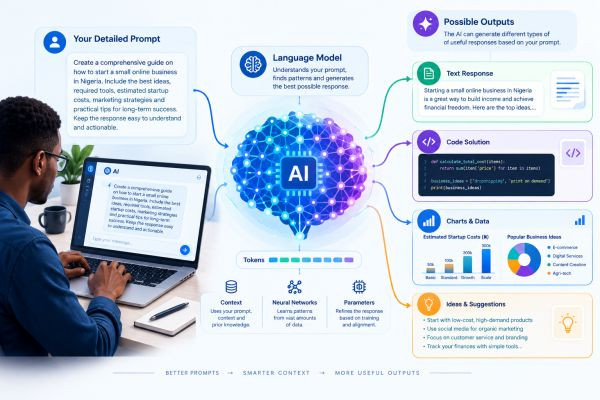
One reason LLMs are powerful is that the same underlying language capabilities can be used for many different tasks.
For example, you can ask an LLM to:
- Explain a difficult concept
- Rewrite a paragraph
- Summarize a document
- Create an outline
- Generate ideas
- Translate text
- Analyze information
- Write or explain code
- Create a business draft
- Help structure a presentation
- Practice a conversation
- Turn notes into a clearer document
The model does not necessarily have a separate "summarization machine" and "email machine."
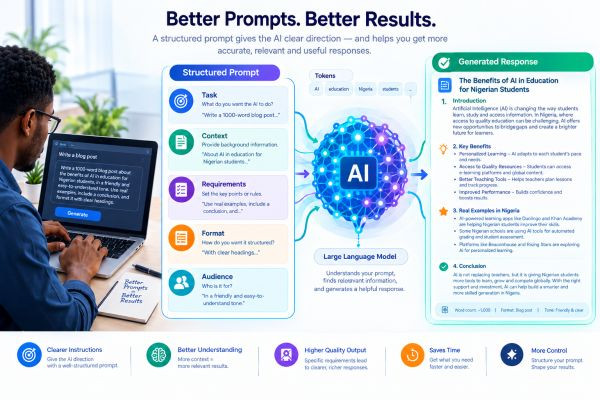
Instead, the prompt and context help guide the model toward the type of output you want.
This is one reason prompting has become an important AI skill.
LLM vs Chatbot: Are They the Same Thing?
No.
An LLM is a model, while a chatbot is an application or interface that can use an AI model to interact with users.
Think of it this way:
LLM = engine
Chatbot = application built around the engine
A chatbot may use an LLM to generate responses, but the complete chatbot can include many other components.
These may include:
- User interface
- Conversation history
- Safety systems
- Search or retrieval tools
- File processing
- External software integrations
- Memory features
- Other AI models
Therefore, an LLM and an AI chatbot should not automatically be treated as the same thing.
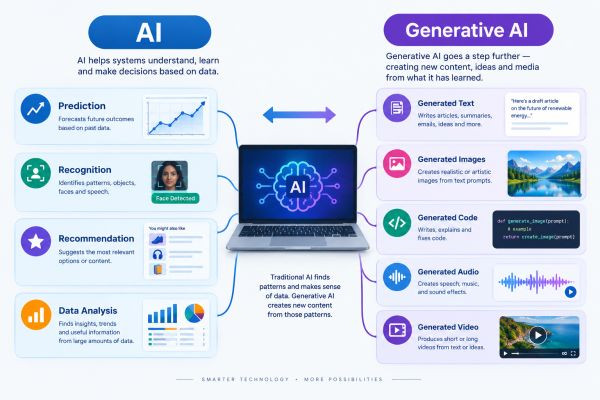
LLM vs Generative AI
LLMs and generative AI are also related but not identical.
Generative AI is the broader category of AI systems that can generate new content.
That content can include:
- Text
- Images
- Audio
- Video
- Code
- Other forms of media or information
An LLM is a type of AI model primarily focused on language-related tasks.
So the relationship can be simplified as:
Artificial Intelligence → Generative AI → Language-focused generative models → LLMs
Not every generative AI system is an LLM.
For example, an image-generation model can generate pictures without being a language model.
What Are LLMs Used For?
Large language models have many potential applications.
1. Learning and Education
Students can use language models to:
- Explain unfamiliar concepts
- Generate practice questions
- Simplify difficult explanations
- Create study outlines
- Compare concepts
- Get help understanding mistakes
The important thing is to use AI as a learning aid rather than automatically accepting every answer it produces.
2. Writing
LLMs can assist with writing tasks such as:
- Brainstorming
- Outlining
- Editing
- Rewriting
- Summarizing
- Improving clarity
- Drafting professional communication
Human review remains important, especially when accuracy and personal judgment matter.
3. Programming
LLMs can also work with programming languages.
They may help users:
- Explain code
- Find possible bugs
- Generate examples
- Understand programming concepts
- Convert code between languages
- Create documentation
However, generated code should be reviewed and tested rather than blindly copied into a real project.
4. Business
Businesses can use language models for tasks such as:
- Drafting documents
- Customer-support assistance
- Internal knowledge search
- Summarizing meetings
- Brainstorming
- Creating first drafts
- Analyzing text
The appropriate use depends on the organization's data, security requirements and workflow.
5. Content Creation
Content creators may use LLMs for:
- Topic research
- Content outlines
- Brainstorming
- Video scripts
- Social media ideas
- Article editing
- Repurposing existing content
The strongest results often come when humans provide the ideas, experience, facts and final editorial judgment.
Why Do LLMs Sometimes Make Things Up?
One of the biggest misunderstandings about language models is assuming that fluent writing automatically means factual accuracy.
It doesn't.
An LLM can sometimes produce information that sounds convincing but is incorrect.
This behavior is often called an AI hallucination.
Why does this happen?
Because a language model's fundamental job is related to generating likely sequences of tokens based on learned patterns and available context.
It is not automatically a perfect fact-checking system.
For example, if you ask a model a question about an obscure topic, it may generate a plausible-sounding answer even when the information is uncertain or unavailable.
That is why important information should be independently verified.
Why LLMs Can Sound Confident Even When They Are Wrong
Human beings often associate confident language with knowledge.
AI systems can create the same impression.
An answer can be:
- Well written
- Detailed
- Grammatically correct
- Structured professionally
and still be inaccurate.
This is particularly important when using AI for:
- Education
- Finance
- Legal matters
- Health information
- Business decisions
- Technical implementation
- Current events
The more important the decision, the more important independent verification becomes.
Do LLMs Know Everything?
No.
An LLM's capabilities depend on its training, architecture, available context, tools and deployment.
A model may also have limitations regarding:
- Recent events
- Specialized subjects
- Ambiguous questions
- Rare information
- Mathematical reasoning
- Complex instructions
- Context length
- Factual accuracy
Some AI applications can connect models to external search, databases or other tools, which can improve their ability to work with information outside the model itself.
But tool access does not remove the need for verification.
Are LLMs the Same as Search Engines?
No.
A search engine and an LLM can both help you find information, but they work differently.
A traditional search engine is primarily designed to retrieve and rank information from available sources.
An LLM primarily generates an answer based on its learned patterns and the context provided to it.
Modern AI systems can combine language models with search and retrieval tools, making the distinction less obvious to users.
Still, it is useful to understand the difference:
Search retrieves information.
An LLM generates language based on its model and available context.
In some systems, both approaches work together.
What Are the Main Advantages of LLMs?
LLMs can be useful because they can:
Work with natural language
You can communicate with them using ordinary language instead of learning a complicated interface.
Handle many different tasks
The same model can assist with writing, explanation, coding, summarization and brainstorming.
Process large amounts of text
Depending on the system's context capabilities, an LLM can analyze substantial amounts of textual information.
Help people work faster
AI can reduce the time required for certain repetitive or first-draft tasks.
Support learning
People can ask follow-up questions and request explanations at different levels of difficulty.
What Are the Limitations of LLMs?
LLMs are powerful tools, but they are not perfect.
Some important limitations include:
1. Incorrect information
The model can generate false or misleading information.
2. Bias
Models can reproduce or amplify patterns and biases present in their training data or other parts of the system.
3. Lack of human experience
An LLM does not have human life experience simply because it can discuss human experiences.
4. Context limitations
A model can only work with the information available within its relevant context and system capabilities.
5. Privacy concerns
Users should be careful about entering confidential, personal or sensitive information into AI services, particularly when they do not understand how the service handles submitted data.
6. Overreliance
Using AI for every decision can reduce the amount of human checking and critical thinking involved.
The goal should not be to replace human judgment wherever possible.
The goal is to use AI where it genuinely helps.
Are Bigger LLMs Always Better?
Not necessarily.
It is easy to assume that a model with more parameters must automatically be superior.
Real-world performance is more complicated.
Models can differ in:
- Architecture
- Training data
- Training techniques
- Fine-tuning
- Reasoning capabilities
- Context handling
- Tool use
- Speed
- Cost
- Accuracy on specific tasks
A smaller model can sometimes be more practical for a particular application because it may be faster, cheaper or easier to run.
Therefore, model size is only one part of the picture.
Why Have LLMs Become So Important?
LLMs have changed how people interact with computers.
For decades, using software often meant learning menus, commands, interfaces or programming languages.
Natural-language AI provides another possibility:
You can describe what you want in ordinary language.
Instead of searching through complicated settings, a person can ask:
"Turn these notes into a professional report."
Or:
"Explain this programming error in simple terms."
Or:
"Give me a study plan for learning Python."
This does not eliminate the need to understand the underlying subject.
But it can make technology more accessible to people who previously found complex software intimidating.
How Can Beginners Start Learning About LLMs?
You do not need to become an AI researcher to start learning about large language models.
A practical learning path could look like this:
Step 1: Learn basic AI concepts
Start by understanding artificial intelligence, machine learning and generative AI.
Step 2: Understand how LLMs work
Learn about:
- Tokens
- Training
- Parameters
- Context
- Inference
- Prompting
Step 3: Experiment with prompts
Try asking an AI system the same question in different ways.
Compare the results.
Step 4: Learn to verify AI output
Don't just ask an AI system for an answer.
Learn how to check whether the answer is accurate.
Step 5: Apply AI to a real task
Use an LLM to help with something useful, such as studying, writing, programming or organizing information.
Step 6: Learn prompt engineering
Once you understand the basics, learn how to give AI clearer instructions and provide useful context.
This will be the subject of a later article in this series.
A Simple Mental Model for Understanding LLMs
If you remember only one thing from this article, remember this:
An LLM is a trained AI model that processes language and generates text by using patterns learned during training and the context provided to it.
The simplified process is:
Training data → Model training → Learned parameters → Prompt → Context processing → Token prediction → Response
It is much more complicated mathematically, but this mental model is enough to understand many of the AI applications you encounter every day.
Frequently Asked Questions About LLMs
What is an LLM in simple terms?
An LLM, or Large Language Model, is an AI model trained on large amounts of data to process and generate language.
What does LLM stand for?
LLM stands for Large Language Model.
Is ChatGPT an LLM?
ChatGPT is an AI application that uses language models as part of its underlying technology. It is more accurate to distinguish the application from the underlying model.
Is an LLM generative AI?
LLMs can be used as generative AI systems because they can generate text. However, generative AI is a broader category that also includes systems designed to generate images, audio, video and other content.
Do LLMs think like humans?
No. Although LLMs can produce sophisticated language, their operation is fundamentally different from human thought and experience.
Can LLMs make mistakes?
Yes. LLMs can generate incorrect, incomplete or misleading information, sometimes in language that sounds very confident.
What is a token in an LLM?
A token is a unit of text processed by a language model. Depending on the tokenizer, a token can represent a word, part of a word, punctuation or another text element.
What is an LLM context window?
A context window is the amount of information, measured in tokens, that a model can consider within a particular processing context.
Are LLMs only useful for writing?
No. LLMs can also assist with learning, programming, summarization, analysis, translation, brainstorming and many other language-related tasks.
Final Thoughts
Large Language Models are one of the technologies behind the rapid growth of modern generative AI.
Understanding them doesn't require you to become a machine-learning engineer.
Start with the basic ideas:
Data → Training → Parameters → Model → Context → Tokens → Prediction → Output
Once you understand this process, concepts such as AI chatbots, prompting, context windows and AI-generated content become much easier to understand.
But perhaps the most important lesson is this:
An LLM is a powerful language-generation tool, not an automatic source of truth.
Use it to explore ideas, learn, create and work more efficiently—but keep human judgment, verification and critical thinking in the process.
As AI becomes increasingly common in education, business and everyday work, understanding how these systems operate will become a valuable form of digital literacy.
Want to continue learning about AI?
Explore the other articles in the OriginCourse AI & Generative AI series to build your understanding step by step—from the fundamentals of artificial intelligence to generative AI, LLMs, prompting and practical applications.
relaterade artiklar