What is artificial intelligence? Learn how AI works, the different types of AI, real-world examples, benefits, limitations, and how beginners can start learning it.
09/18/26 • 552 ভিউ

What Is Artificial Intelligence? A Simple Guide for Beginners
Artificial intelligence, usually called AI, has moved from something that sounded like science fiction to something many of us interact with every day.
When your phone recognizes your face, a streaming service recommends a movie, your email filters spam, or an AI chatbot answers a question, there is a good chance artificial intelligence is involved somewhere in the process.
But what exactly is AI?
You don't need to be a programmer or technology expert to understand it. At its simplest, artificial intelligence is about building computer systems that can perform tasks that normally require some form of human intelligence, such as recognizing patterns, understanding language, making predictions, or helping with decisions.
In this guide, we'll break down what artificial intelligence means, how it works, the different types of AI, everyday examples, its benefits and limitations, and how a beginner can start learning about the technology.
What Is Artificial Intelligence?
Artificial intelligence is the field of technology focused on creating computer systems that can perform tasks associated with human intelligence.
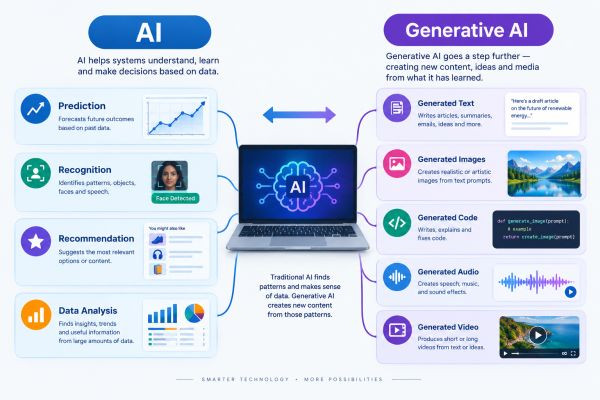
These tasks can include:
- Understanding and processing language
- Recognizing images or sounds
- Finding patterns in data
- Making predictions
- Recommending information
- Solving certain problems
- Generating text, images, audio or code
A simple way to think about AI is this:
«AI allows computers to perform certain tasks in ways that can appear intelligent to people.»
However, this does not mean that today's AI systems think or understand the world exactly as humans do.
Most modern AI is designed for particular tasks and depends heavily on data, algorithms, models and computing resources.
How Does Artificial Intelligence Work?
The details can become very technical, but the basic idea is easier to understand.
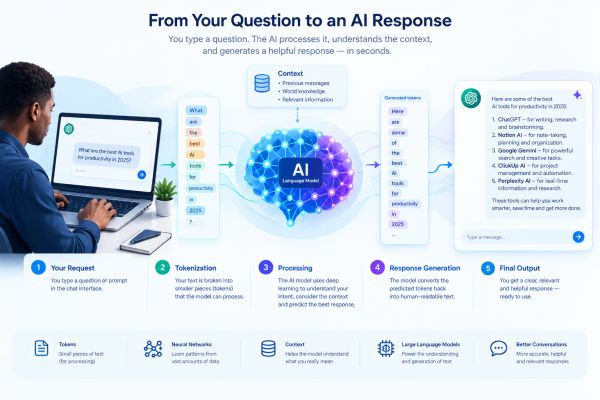
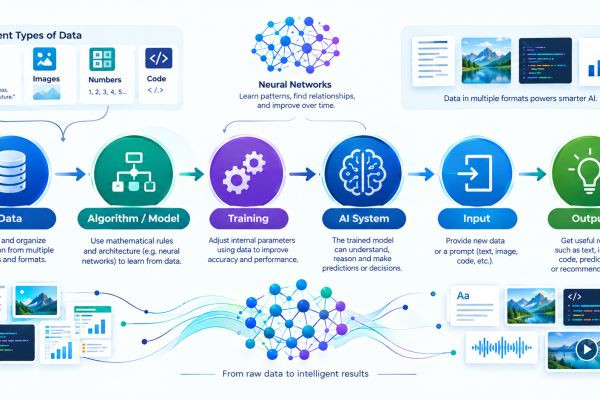
An AI system generally needs data, a method for learning from or processing that data, and computing resources to build or run the resulting model.
For example, imagine you wanted a computer system to identify pictures of cats.
You could provide it with a large collection of images and information about what each image contains. A machine-learning system can use those examples to identify patterns that are useful for distinguishing cats from other objects.
Once trained, the model can examine a new image and produce a prediction about what it contains.
The important point is that the computer isn't simply following one instruction that says:
«"If you see two ears, whiskers and four legs, it's a cat."»
Modern machine-learning systems can learn complicated patterns from large amounts of data.
Data
Data is one of the most important ingredients in modern AI.
Depending on the application, data could include:
- Text
- Images
- Audio
- Video
- Numbers
- Sensor information
- User interactions
The quality and relevance of the data can affect the performance of an AI system.
Algorithms and Models
An algorithm is a set of computational procedures used to process information or solve a problem.
A model is a system that has been trained or configured to recognize patterns and produce useful outputs.
Machine learning allows models to learn patterns from data rather than requiring developers to manually program every possible situation.
Training
During training, a machine-learning model processes examples and adjusts its internal parameters based on those examples.
This process can require substantial computing power, especially for large modern AI models.
After training, the model can be used to process new information.
Inference
When an already-trained model receives new information and produces an output, this is generally referred to as inference.
For example, when an AI model receives a question and generates an answer, the model is performing inference.
What Are the Different Types of Artificial Intelligence?
People often divide AI into different categories. Some classifications describe AI according to its capabilities, while others describe it according to how it operates.
For everyday discussions, you will often hear about narrow AI, artificial general intelligence (AGI) and artificial superintelligence (ASI).
1. Narrow AI
Narrow AI, sometimes called weak AI, is designed to perform specific tasks or a limited range of tasks.
Most AI systems available today fall into this category.
Examples include systems used for:
- Speech recognition
- Image recognition
- Recommendations
- Spam detection
- Translation
- Fraud detection
- Navigation
- AI assistants
A system can be extremely capable at its particular task without possessing general human-like intelligence.
2. Artificial General Intelligence
Artificial General Intelligence (AGI) is a concept referring to AI with much broader, general-purpose intellectual capabilities.
Unlike a system designed primarily for a particular task, an AGI system would be expected to handle a wide variety of intellectual tasks.
AGI remains a subject of significant research and debate, and there is no universally accepted test or definition that settles when such a system has been achieved.
It is therefore important to distinguish discussions about AGI from the capabilities of AI products that people use today.
3. Artificial Superintelligence
Artificial Superintelligence (ASI) is a hypothetical concept describing AI that would surpass human capabilities across a very broad range of intellectual tasks.
ASI is mainly discussed in theoretical research and debates about the long-term future of AI.
It should not be confused with the AI systems currently available to consumers and businesses.
What Is Machine Learning?
You will often hear machine learning mentioned whenever people discuss artificial intelligence.
Machine learning is a major approach within AI in which computer systems learn patterns from data and use those patterns to make predictions or decisions.
For example, an online store could use machine learning to identify patterns in customer behavior and recommend products that may be relevant to a particular customer.
Machine learning can be used for tasks such as:
- Classification
- Prediction
- Recommendation
- Pattern recognition
- Anomaly detection
In simple terms:
AI is the broader field, while machine learning is one important approach used to build AI systems.
What Is Deep Learning?
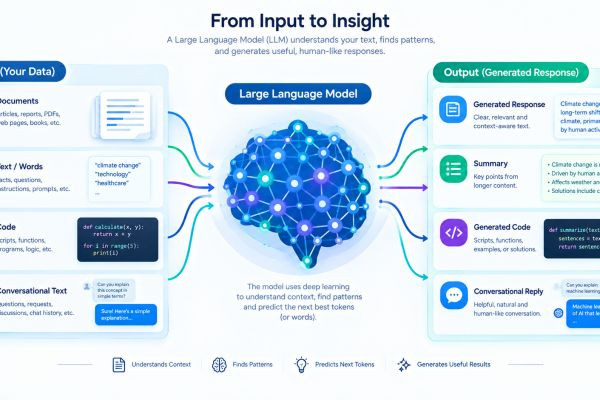
Deep learning is a type of machine learning that uses neural networks with multiple layers.
Deep-learning techniques have played an important role in advances in areas such as:
- Computer vision
- Speech recognition
- Natural-language processing
- Generative AI
The word "deep" refers broadly to the multiple layers involved in these neural networks.
You don't need to understand the mathematics behind neural networks to begin learning how AI is used. Understanding the basic concepts is a good starting point.
What Is Generative AI?
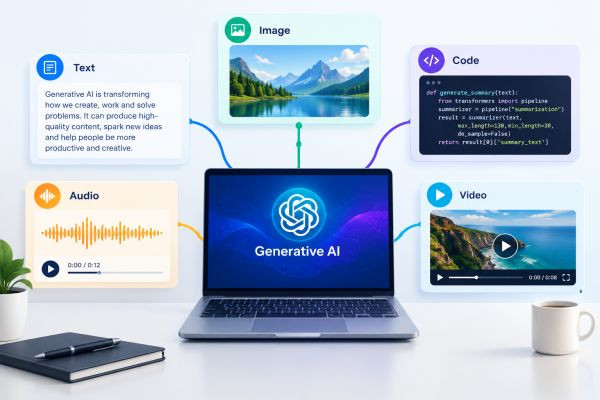
Generative AI is a branch of AI that can create new content based on patterns learned during training.
Depending on the system, that content can include:
- Text
- Images
- Audio
- Video
- Computer code
AI chatbots and other generative AI applications have made this area particularly visible to the general public.
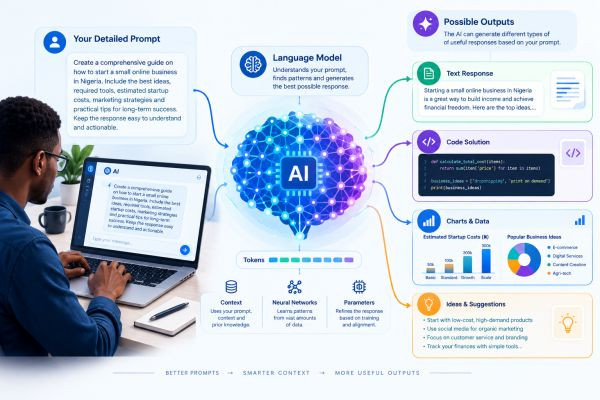
For example, a generative AI system can receive a written instruction and produce a response in natural language.
This is one reason generative AI has become an important area within the broader AI landscape.
We'll explore it in much greater detail in the next article in this series:
What Is Generative AI? How It Works and What You Can Do With It
Examples of Artificial Intelligence in Everyday Life
You may already use AI more often than you realize.
Smartphone Features
Modern smartphones can use AI-related technologies for:
- Face recognition
- Voice assistants
- Camera processing
- Predictive text
- Photo organization
Search Engines
Search systems use sophisticated algorithms and machine-learning techniques to understand queries and help identify relevant information.
Streaming Recommendations
Music and video platforms can analyze patterns in your interactions and use recommendation systems to suggest content.
Email Spam Filters
Email services can use machine-learning techniques to identify messages that resemble unwanted or malicious email.
Maps and Navigation
Navigation applications can process information about roads, traffic and routes to help users plan journeys.
Online Shopping
E-commerce platforms can use recommendation systems to suggest products based on information such as browsing and purchasing behavior.
Customer Service
Businesses increasingly use AI-powered systems to answer common questions, classify requests and assist customer-service teams.
Generative AI Tools
Generative AI applications can help users create or transform:
- Written content
- Images
- Presentations
- Code
- Summaries
- Ideas and outlines
The exact capabilities vary considerably between systems.
Why Is Artificial Intelligence Important?
AI matters because computers can process enormous amounts of information and perform certain tasks much faster than people can.
Businesses, researchers, governments and individuals are exploring AI for many different purposes.
Some potential benefits include:
Increased Productivity
AI can assist with repetitive or time-consuming tasks, allowing people to focus more attention on work that requires judgment and creativity.
Faster Analysis
AI systems can process large datasets and identify patterns that might be difficult to find manually.
Personalization
Recommendation and learning systems can adapt information or experiences based on user data and behavior.
Accessibility
AI-powered speech, translation and assistive technologies can make certain digital experiences easier for more people to use.
New Ways to Learn and Create
Generative AI has made it easier for people to experiment with writing, coding, images and other forms of digital creation.
But these benefits do not mean AI should automatically replace human decision-making.
What Are the Limitations of Artificial Intelligence?
Understanding AI also means understanding what it cannot reliably do.
AI systems can produce impressive results while still making mistakes.
AI Can Produce Incorrect Information
An AI system can generate an answer that sounds convincing but is factually wrong.
This is particularly important when dealing with subjects such as finance, health, law, academic research or current events.
Important information should be independently verified.
AI Can Reflect Problems in Its Data
AI systems learn from data, and data can contain errors, gaps or biases.
As a result, AI outputs can sometimes reflect problems present in the underlying data or system design.
AI Does Not Automatically Understand Context Like a Human
An AI system may process language remarkably well without possessing human experience or understanding in the same way a person does.
This is one reason human judgment remains important.
AI Can Be Overused
Using AI for everything can create new problems.
For example, someone who relies on AI to answer every question without checking the information may gradually become less careful about evaluating sources.
The goal should not simply be to use more AI.
The goal should be to use AI appropriately.
Is Artificial Intelligence the Same as Human Intelligence?
No.
Although AI systems can perform tasks that appear intelligent, artificial intelligence and human intelligence are not the same thing.
Humans learn through a combination of experience, perception, social interaction, reasoning and many other processes.
AI systems operate through computational models, training processes, data and algorithms.
An AI system may outperform humans at a particular task while being unable to perform other seemingly simple tasks outside its design or training.
That distinction is important when evaluating what AI can and cannot do.
How Can Beginners Start Learning Artificial Intelligence?
You don't need to start with advanced mathematics or programming.
A practical learning path can begin with understanding the fundamentals.
Step 1: Learn the Basic Concepts
Start with:
- Artificial intelligence
- Machine learning
- Deep learning
- Generative AI
- Large language models
- AI prompts
Step 2: Experiment With AI Tools
Use AI applications for practical tasks such as:
- Brainstorming
- Learning
- Summarizing information
- Writing and editing
- Coding
- Research assistance
The goal is not simply to experiment randomly. Pay attention to how the quality of your instructions affects the results.
Step 3: Learn Prompting
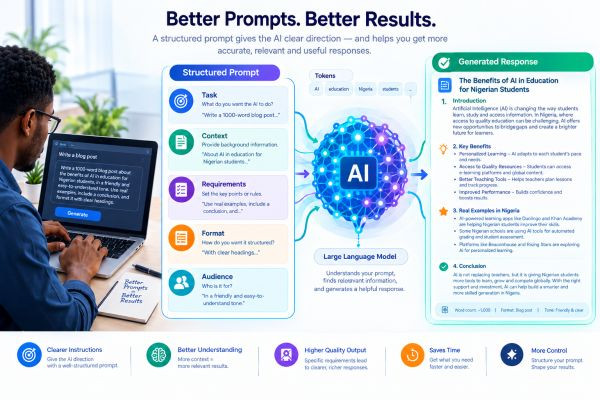
A clear prompt can make a significant difference when working with generative AI.
Learn how to provide:
- Context
- Instructions
- Examples
- Desired output format
- Constraints
Our upcoming article on Prompt Engineering for Beginners will explore this in more detail.
Step 4: Choose a Specialization
Once you understand the basics, consider an area that matches your interests.
You could explore:
- AI for business
- AI for education
- AI for content creation
- AI automation
- AI-assisted programming
- Data analysis
- AI research
- Generative AI
Step 5: Build Practical Projects
Knowledge becomes much more useful when you apply it.
Instead of only watching tutorials, try building small projects or workflows.
For example, you could create an AI-assisted content workflow, experiment with data analysis, or develop a simple application if you have programming experience.
Common Questions About Artificial Intelligence
Is AI difficult to learn?
The answer depends on what you want to do with it.
Learning basic AI concepts does not require advanced programming. Becoming an AI engineer or researcher, however, can require substantial knowledge of mathematics, programming, statistics and computer science.
Do I need to know programming to use AI?
No.
Many AI applications are designed for people without programming experience.
Programming becomes more important if you want to build AI systems, work with APIs, develop applications or pursue technical AI careers.
Is ChatGPT artificial intelligence?
Yes. ChatGPT is an example of an AI application that uses generative AI technology.
It can process user prompts and generate responses in natural language.
Will AI replace human workers?
AI is changing how many tasks are performed, but the effects vary significantly between industries, occupations and individual tasks.
Some work may become automated, while other roles may increasingly involve working alongside AI systems.
It is more useful to think about which tasks AI can assist with than to assume that every occupation will simply disappear.
Is generative AI the same as artificial intelligence?
No.
Generative AI is a category within the broader field of artificial intelligence.
AI includes many applications that don't generate new content, such as recommendation systems, fraud detection and classification systems.
Final Thoughts
Artificial intelligence is a broad field, and you don't need to understand every technical detail before you can start exploring it.
The most useful starting point is to understand the basic ideas: AI, machine learning, deep learning, generative AI and large language models.
From there, you can begin experimenting with AI tools and eventually explore applications that are relevant to your education, career, business or personal projects.
The technology will continue to evolve, but one thing is already clear: understanding how to work with AI is becoming an increasingly useful digital skill.
Want to continue learning?
Next, we'll take a closer look at one of the fastest-growing areas of AI:
What Is Generative AI? How It Works and What You Can Do With It.
Explore more practical technology and digital-skills learning resources on OriginCourse.
সম্পরকিত প্রবন্ধ