- AI en generatieve AI
- Technologie en programmeren
- Bedrijfsvoering en ondernemerschap
- Digitale marketing
- Microsoft Office & productiviteit
- Gegevens en analyses
- Financiën en boekhouding
- Ontwerp- en creatieve vaardigheden
- Loopbaan- en professionele ontwikkeling
- Freelancen en werken op afstand
- How-To & Style
- Onderwijs en lesgeven
- Vertrouwen
What is generative AI? Learn how it works, what it can create, practical uses, benefits, limitations, and how beginners can start using it.
09/18/26 • 578 Bekeken

What Is Generative AI? How It Works and What You Can Do With It
Generative AI has quickly become one of the most talked-about areas of technology.
You can ask an AI tool to explain a difficult subject, turn an idea into an image, help organize a document, write computer code, summarize information, or create a first draft of something you are working on.
That can feel almost magical the first time you use it.
But generative AI isn't magic. Behind those impressive results are models trained to recognize patterns in large amounts of data and generate new outputs based on the instructions they receive.
So, what is generative AI, exactly?
In simple terms, generative AI is a type of artificial intelligence that can create new content such as text, images, audio, video, and computer code in response to a user's instructions.
This guide explains how generative AI works, the different types of content it can create, what people are using it for, its benefits and limitations, and how beginners can start using the technology responsibly.
What Is Generative AI?
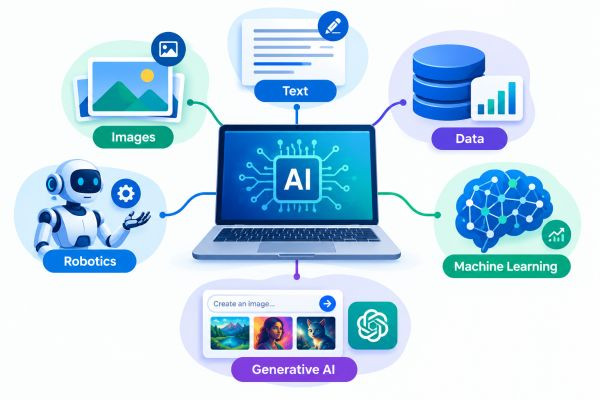
Generative AI is a type of artificial intelligence designed to generate new content based on patterns learned from data.
The content can take different forms, including:
- Text
- Images
- Audio
- Music
- Video
- Computer code
- Summaries
- Other digital content
For example, you might give a generative AI application a prompt such as:
«"Explain photosynthesis to a 12-year-old using a simple example."»
The system can then generate an explanation based on patterns it learned during training.
Similarly, you could provide an image-generation system with a description of a scene and receive a newly generated image.
The important distinction is that generative AI doesn't simply retrieve one pre-written answer from a database. Generative systems produce outputs based on their learned representations and the input they receive.
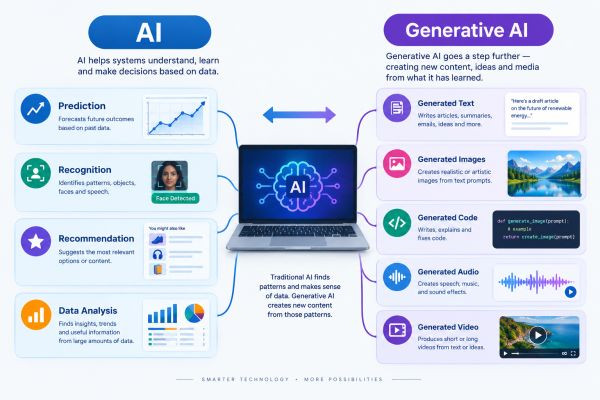
How Is Generative AI Different From Traditional AI?
Artificial intelligence is a broad field.
Generative AI is one part of that broader field.
Traditional AI systems can be designed to classify information, make predictions, identify patterns, recommend products, detect unusual activity, or perform other specific tasks.
Generative AI focuses on creating new content.
For example:
AI application| What it does
Spam detection| Classifies unwanted messages
Recommendation system| Suggests relevant content
Fraud detection| Identifies suspicious patterns
Image recognition| Identifies objects or features
Generative AI| Creates new text, images, audio, video or code
The boundaries aren't always perfectly simple because modern AI systems can combine several capabilities.
The key idea is this:
AI is the broader technology field, while generative AI refers to AI systems capable of producing new content.
If you haven't read our first article yet, you can start with What Is Artificial Intelligence? A Simple Guide for Beginners.
How Does Generative AI Work?
The technology behind generative AI can become highly technical, but the basic process can be explained without advanced mathematics.
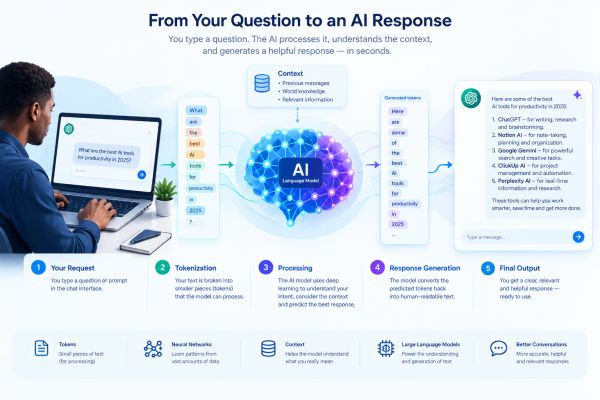
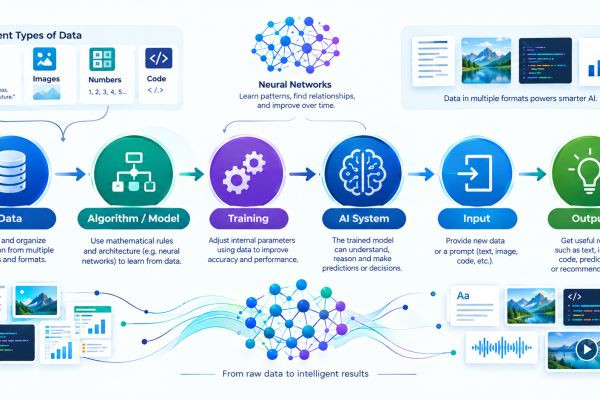
A simplified process looks something like this:
Training data → AI model → learning patterns → user prompt → generated output
Let's break that down.
1. Training Data
Generative AI models are trained using large amounts of data.
Depending on the type of model, the training material may contain:
- Text
- Images
- Audio
- Video
- Code
- Other forms of digital information
The data gives the model examples from which it can learn patterns.
The exact data and training methods differ between AI systems.
2. The Model Learns Patterns
During training, the model processes examples and adjusts its internal parameters.
For a language model, this can involve learning relationships between words and pieces of text.
For an image-generation model, the training process can involve learning relationships between visual patterns and other information.
The model isn't memorizing a simple list of instructions for every possible question.
Instead, training creates a complex mathematical representation that allows the system to produce outputs based on learned patterns.
3. You Provide a Prompt
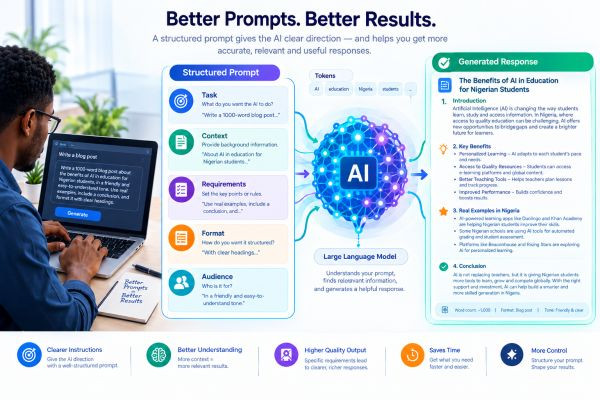
A prompt is the instruction or information you give an AI system.
For example:
«"Write a simple explanation of compound interest for a beginner."»
The prompt provides the model with information about what you want it to produce.
The clearer your request, the easier it can be for the system to understand the desired task and format.
4. The Model Generates an Output
The model processes the prompt and generates an output.
For text-generation systems, this involves predicting what tokens should come next based on the input and the model's learned patterns.
The result is a newly generated response.
This process happens quickly, which is one reason generative AI feels so different from older computer applications.
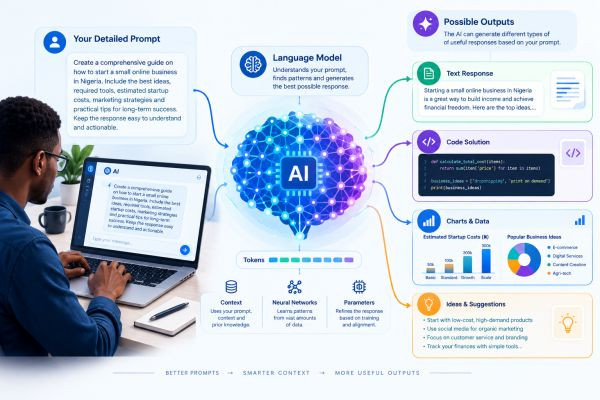
What Can Generative AI Create?
Generative AI is not limited to chatbots.
Different models and applications specialize in different types of content.
Text
Text-generation systems can help produce:
- Articles
- Emails
- Summaries
- Outlines
- Explanations
- Brainstorming ideas
- Stories
- Product descriptions
- Study materials
The quality depends on the model, prompt, context and task.
Images
Image-generation systems can create images from written descriptions.
For example, a user could describe:
- A landscape
- A fictional character
- A business illustration
- A product concept
- An educational diagram
- A particular artistic style
AI-generated images can be useful for brainstorming and visual content, but users should still consider accuracy, originality, copyright and licensing requirements where relevant.
Audio
Generative AI can also be used to create or transform audio.
Applications can include:
- Speech generation
- Voice-related tools
- Audio effects
- Music generation
- Transcription and transformation
The capabilities and restrictions differ significantly between tools.
Video
AI video generation is developing rapidly.
Depending on the application, users may be able to generate or modify video from text, images or other inputs.
Potential applications include:
- Marketing concepts
- Educational content
- Storyboarding
- Visual experimentation
- Short-form media
The technology continues to evolve, so capabilities that exist today may change considerably over time.
Computer Code
Generative AI can also produce computer code.
Developers may use AI systems to:
- Explain code
- Generate example code
- Find potential bugs
- Convert code between languages
- Create tests
- Understand unfamiliar programming concepts
However, generated code should be reviewed and tested rather than automatically assumed to be correct or secure.
What Is a Generative AI Model?
A generative AI model is a machine-learning model designed to generate new outputs.
There isn't one single type of generative AI model.
Different architectures and techniques are used for different tasks.
Some systems specialize in language, while others are designed for images, audio, video or combinations of different data types.
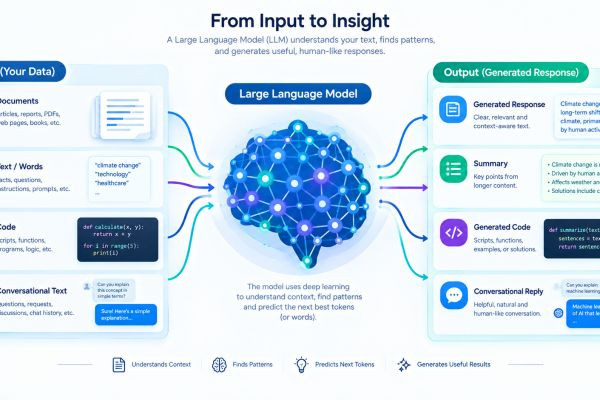
Large Language Models
Large language models, commonly called LLMs, are designed to process and generate language.
They power many modern AI assistants and chatbots.
An LLM can process a prompt and generate a response based on patterns learned during training.
We'll explore LLMs in more detail in Article #5: What Is a Large Language Model (LLM)?
Image Generation Models
Image-generation models are designed to create or transform visual content.
They can take text or other inputs and generate images that match the requested characteristics.
Multimodal AI
Some newer AI systems can work with multiple types of information.
For example, a system may be able to process combinations of:
- Text
- Images
- Audio
- Video
This is often described as multimodal AI.
It allows people to interact with AI using more than just written text.
Why Has Generative AI Become So Popular?
One major reason is accessibility.
You no longer need to understand how an AI model is built to experiment with some of its capabilities.
A person can open an AI application, type a request in ordinary language and receive an output within seconds.
That changes the way people interact with software.
Instead of navigating through dozens of menus, users can sometimes describe what they want in their own words.
For students, freelancers, employees, creators and business owners, that can make certain digital tasks easier to start.
But convenience shouldn't be confused with accuracy.
An AI-generated answer can still be incomplete or wrong.
How Are People Using Generative AI?
The practical applications are broad.
1. Learning
Students and independent learners can use generative AI to:
- Explain unfamiliar concepts
- Create practice questions
- Summarize material
- Generate examples
- Build study plans
- Explore different explanations
It works best as a learning assistant rather than something that does all the thinking for the learner.
2. Writing
Writers can use generative AI for:
- Brainstorming
- Outlining
- Editing
- Rewriting
- Summarizing
- Exploring alternative approaches
A human should remain responsible for the final content, especially when accuracy matters.
3. Programming
Developers can use AI to help understand and produce code.
For beginners, this can also make programming concepts easier to explore.
However, generated code should be tested carefully.
4. Business
Businesses can experiment with generative AI for:
- Marketing ideas
- Customer-support drafts
- Internal documentation
- Research assistance
- Content planning
- Data interpretation
- Brainstorming
The appropriate use depends on the business and the sensitivity of the information involved.
5. Content Creation
Creators can use AI as part of workflows for:
- Articles
- Social media ideas
- Images
- Video concepts
- Scripts
- Headlines
- Content calendars
The strongest results often come from combining AI assistance with human expertise, editing and original ideas.
6. Translation and Communication
AI can help people translate, rewrite and simplify information.
This can make communication across languages or reading levels easier, although important translations may still require qualified human review.
What Are the Benefits of Generative AI?
Generative AI offers several potential advantages.
It Can Save Time
AI can quickly create a first draft, summarize information or generate ideas.
That doesn't mean the final result is automatically ready to publish.
But reducing the time spent on a blank page can be useful.
It Can Help With Brainstorming
Sometimes the hardest part of a project is getting started.
Generative AI can produce possible approaches that a person can evaluate, modify or reject.
It Can Make Complex Topics Easier to Explore
Users can ask for different explanations of the same subject.
For example:
«"Explain this like I'm a beginner."»
Then:
«"Now explain it using a practical business example."»
That flexibility can make learning more interactive.
It Can Assist People With Different Skill Levels
Someone who has never written code can ask for an explanation of a programming concept.
A professional developer can use the same technology for a different purpose, such as reviewing or restructuring code.
The value comes from how the tool is applied.
What Are the Limitations of Generative AI?
Generative AI is powerful, but it isn't infallible.
Understanding its weaknesses is just as important as understanding its capabilities.
AI Can Make Things Up
Generative AI can sometimes produce information that sounds convincing but isn't correct.
This is sometimes referred to as an AI hallucination.
If an answer involves important facts, dates, statistics, scientific claims or current events, verify the information using reliable sources.
AI Can Produce Biased Results
AI systems learn from data and other design choices.
Problems in those inputs or processes can affect outputs.
This is one reason AI systems should be evaluated rather than treated as completely neutral authorities.
AI Doesn't Automatically Know What You Mean
A short or ambiguous prompt can produce an answer that isn't useful simply because the system interpreted the request differently from what you intended.
Providing context can improve the result.
AI Output Still Requires Human Judgment
An AI system can generate a polished paragraph in seconds.
That doesn't mean the paragraph is accurate, appropriate or original.
Human review remains important.
Privacy Matters
You should be careful about entering sensitive personal, financial, business or confidential information into AI services.
Before using an AI tool for sensitive work, understand how the service handles submitted information and what controls are available.
AI Isn't a Replacement for Expertise
AI can support experts and help beginners learn, but it shouldn't automatically replace professional judgment in areas where mistakes can have serious consequences.
Does Generative AI Copy Other People's Work?
This question is more complicated than a simple yes-or-no answer.
Generative AI models learn patterns from training data, but the way individual models are trained and the sources involved can vary.
There are also ongoing legal and policy debates concerning training data, copyright, ownership and the use of AI-generated content.
As a user, the practical lesson is straightforward:
Don't assume that everything generated by an AI system is automatically free of copyright or other legal considerations.
When creating content for commercial use, check the relevant tool's terms and applicable laws.
Is Generative AI the Future?
Generative AI is likely to remain an important area of technology, but predicting exactly what it will look like years from now is difficult.
The technology is developing quickly.
Models are becoming more capable, AI applications are being integrated into existing software, and organizations are experimenting with new ways to use them.
Rather than trying to predict every future development, a more useful approach is to understand the fundamentals and learn how to evaluate AI tools critically.
People who understand both the capabilities and limitations of AI will be better positioned to use it effectively as the technology changes.
How Can a Beginner Start Learning Generative AI?
You can start without becoming an AI engineer.
Start With the Fundamentals
Learn what these terms mean:
- Artificial intelligence
- Machine learning
- Deep learning
- Generative AI
- Large language models
- Prompts
- AI agents
- Multimodal AI
You don't need to master all of them at once.
Experiment With Simple Tasks
Try using an AI tool to:
1. Explain a difficult topic.
2. Generate ideas for a project.
3. Summarize information you've provided.
4. Rewrite something for a different audience.
5. Create a study plan.
6. Help you understand a piece of code.
Pay attention to the quality of the results.
Learn How to Write Better Prompts
The way you communicate with an AI system matters.
Instead of:
«"Tell me about marketing."»
Try:
«"Explain five basic digital marketing strategies to a beginner who runs a small online business. Give one practical example for each strategy."»
The second request provides more context and a clearer outcome.
We'll explore prompting more deeply in our upcoming articles.
Develop a Healthy Verification Habit
Don't automatically believe an AI response simply because it is written confidently.
Ask:
- Is this information current?
- Where did the information come from?
- Can I verify the important claims?
- Does the answer make sense?
- Could there be another interpretation?
This habit becomes increasingly important as AI becomes more common.
Generative AI vs Artificial Intelligence: Quick Comparison
Feature| Artificial Intelligence| Generative AI
Scope| Broad field| Part of AI
Main purpose| Perform intelligent computational tasks| Generate new content
Can make predictions?| Yes| Some systems can
Can classify information?| Yes| Depending on the system
Can generate text?| Some AI systems| Yes
Can generate images?| Some AI systems| Yes
Can generate code?| Some AI systems| Yes
Examples| Recommendation and detection systems| Text, image, audio and code generators
The categories can overlap, but this comparison provides a useful starting point.
Frequently Asked Questions
What is generative AI in simple words?
Generative AI is technology that can create new content, such as text, images, audio, video or code, based on instructions and patterns learned during training.
Is ChatGPT generative AI?
Yes. ChatGPT is an example of a generative AI application that can generate natural-language responses to user prompts.
Do I need coding skills to use generative AI?
No. Many generative AI applications can be used through ordinary language without programming.
Coding becomes useful when you want to build applications, integrate AI into software or work more deeply with AI technologies.
Is generative AI the same as machine learning?
No. Machine learning is a major approach within AI. Generative AI describes AI systems that can generate new content.
Many generative AI systems are built using machine-learning techniques.
Can generative AI create original content?
Generative AI can produce new outputs based on patterns learned during training and the user's input. Whether a particular output qualifies as legally "original," who owns it, and what rights apply can depend on the circumstances and applicable law.
Can generative AI make mistakes?
Yes.
Generative AI can produce incorrect, incomplete or misleading information. Important information should be checked against reliable sources.
Is generative AI only useful for programmers?
No.
Generative AI can be useful for students, teachers, writers, designers, entrepreneurs, researchers, office workers, developers and many other groups.
Its usefulness depends on the task.
Final Thoughts
Generative AI has changed the way ordinary people can interact with powerful computing systems.
You can describe an idea in natural language and receive text, images, code or other digital content within seconds.
But learning to use generative AI effectively involves more than knowing which button to press.
You need to understand what the technology can do, where it can fail, how to give useful instructions, and when an AI-generated result needs to be checked by a human.
That balance is important.
AI can be a powerful assistant, but you remain responsible for how you use its output.
If you're starting your AI journey, understanding generative AI is a good next step after learning the basics of artificial intelligence.
Continue the OriginCourse AI series:
→ What Is AI vs Generative AI? What's the Difference?
→ How Does Artificial Intelligence Work? A Beginner-Friendly Explanation
→ What Is a Large Language Model (LLM)? A Simple Explanation
→ What Is an AI Prompt? A Beginner's Guide to Prompting
Explore more practical technology and digital-skills learning resources on OriginCourse.
Relaterte artikler